



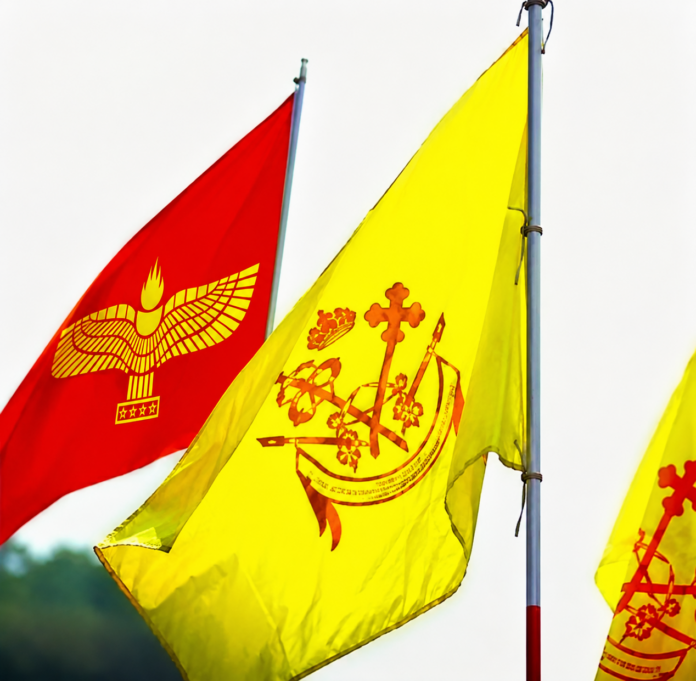
The writer at Hujådå/Huyada keeps asking over and over whether we are “the same people,” but the only thing you actually demonstrate is that you still refuse to accept the people’s own answer. Because if you truly accepted that we are one people, you would also accept the people’s living self-designation instead of constantly trying to correct, reformulate, and ideologically discipline it.
We are Syriacs (Arameans). In our church, our language, our liturgy, our history, and our culture. That identity was carried by our people long before today’s nationalist projects existed, and it will remain long after they disappear.
Within our people there are groups that have chosen historical and political narratives different from the Syriac (Aramean) heritage through which our people have historically been known. They are free to do so. They are still part of the same people, but within the Syriac (Aramean) tradition and continuity shaped through our church, our language, and our history.
And that is where your entire argument collapses.
You try to portray Syriac institutions as exclusionary simply because they use their own names, while you yourselves never live according to the principles you demand from others. When did Hujådå consistently begin using “Syriacs (Arameans)” in your own texts? When did you start displaying Syriac flags in the name of neutrality? When did you yourselves begin practicing the inclusion you so aggressively demand from others?
The answer is as simple as it is uncomfortable.
Never.
You demand from others what you are not even willing to consider yourselves. And yet you attempt to present yourselves as champions of unity. It is difficult to call that anything other than intellectual dishonesty.
At the same time, you speak about the church not being political, while you yourselves have reduced every word, symbol, and formulation into a nationalist loyalty test. Every designation must be scrutinized. Every expression must be controlled. Every Syriac institution must publicly legitimize your definition of identity in order to avoid being accused of division.
And perhaps most remarkably of all, you seem to assume that people and institutions are somehow accountable to you and obligated to provide ideologically approved answers to your recurring interrogations. Who exactly gave you that position?
It no longer comes across as conviction.
It is beginning to look like desperation.
Especially when your own platforms consist almost exclusively of Assyrian nationalist symbols and messaging, while you simultaneously attempt to market yourselves as neutral defenders of “unity.” No one who genuinely wants to unite people spends their time constantly questioning other people’s self-designation.
You say that you want to unite the people, yet your entire rhetoric is built on the idea that people must first accept your ideological framework in order to be considered legitimate. That is not unity. It is identity-political control wrapped in ecclesiastical decoration.
The truth is far simpler than your endless articles try to make it appear. People identify themselves as Syriacs (Arameans) because that is the identity they themselves have carried forward through generations. Not because some organization approved it, and certainly not because Hujådå allowed it.
And the more you try to fight that reality, the clearer it becomes that the problem was never division.
The problem is that you cannot handle the fact that the people’s answer did not become your own.
Perhaps that is also why your texts increasingly begin to resemble frustration that reality refuses to conform to your ideology.
Is the answer clear enough now?
The Antioch Bookstore