


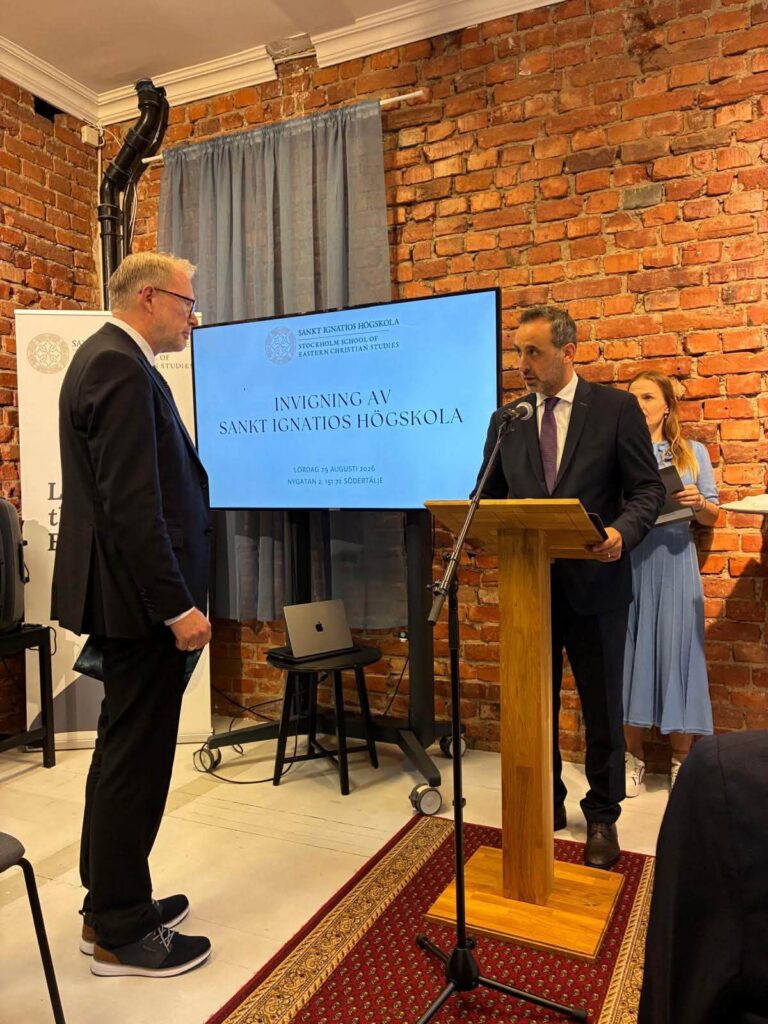
Saint Ignatios College has been formally inaugurated as an independent institution of higher education. The ceremony took place on 29 August in the presence of representatives of churches, academia and the Swedish government. Following a government decision, the college has been granted the right to award a Master’s degree in Eastern Christian Studies, making it Sweden’s first independent institution of higher education with this particular academic focus.
The inauguration marks the culmination of a development spanning more than a decade. The Saint Ignatios Foundation was established in 2013 and has since worked to create an academic environment in Sweden centred on the Eastern Christian traditions.
Among those attending the formal inauguration on Saturday, 29 August, were Cardinal Anders Arborelius, Syriac Orthodox Archbishop Youhanon Lahdo and State Secretary Maria Nilsson, together with a large number of other guests.
During the ceremony, Dr Michael Hjälm was also formally installed as Rector of Saint Ignatios College. The installation was conducted by Yusuf Aydin, Chairman of the College’s Board, who has been involved in the institution since the foundation was established.
“This is more than a success for the college. It is a recognition of the important presence of the Orthodox Churches in Sweden and of the rightful place of the Eastern Christian traditions within Swedish academia,” Yusuf Aydin wrote following the inauguration.
Independent Degree-Awarding Powers
The Swedish Higher Education Authority (UKÄ) has reviewed Saint Ignatios’ capacity to provide education at the advanced level. The institution was found to meet the required standards and, following a government decision, has been granted the right to award a Master’s degree in Eastern Christian Studies.
The change follows a multi-year process aimed at establishing Saint Ignatios as an independent institution of higher education.
This means that Saint Ignatios no longer needs to provide its academic programmes under the degree-awarding powers of another institution. Instead, it can operate independently and award the relevant degree in its own name.
Previously, a significant part of the college’s higher education activities was conducted in cooperation with University College Stockholm (Enskilda Högskolan Stockholm, EHS). From autumn 2026, Saint Ignatios enters a new phase in which its higher education programmes will be provided independently.
Syriac and Other Eastern Christian Traditions within Academia
For the Syriac/Aramean community, this development carries particular significance.
Saint Ignatios is not a college for one single church, but brings together several Eastern Christian traditions. It provides an academic environment in which the theology, history, liturgy and ecclesiastical heritage of the Syriac Orthodox tradition meet those of other Oriental Orthodox, Eastern Orthodox and Eastern Christian traditions.
This means that ecclesiastical traditions with roots stretching back many centuries – in several cases nearly two thousand years – in the Middle East, Africa, India and Eastern Europe are gaining a clearer institutional presence within Swedish higher education.
For the Syriac Orthodox Church and the Syriac/Aramean population in Sweden, this is particularly significant. Over several decades, Sweden has become one of the most important countries in the diaspora of the Syriac Orthodox Church, with Södertälje emerging as one of its major centres.
The establishment here of a college with Eastern Christian Studies as a core academic field creates new opportunities for the academic study of the theology, history, languages, liturgy and culture of the Eastern Churches.
A Journey That Began in 2013
Yusuf Aydin, the current Chairman of the Board of Saint Ignatios, was involved when the foundation was established in 2013. He therefore describes the inauguration as a particularly meaningful moment after more than a decade of work.
“As Chairman and as one of those who have been involved since the beginning, when we established the foundation in 2013, it was a special moment to see a vision that we have carried and worked towards for more than a decade reach this historic milestone,” Aydin wrote.
The path towards independence has not been straightforward. Saint Ignatios previously applied for more extensive degree-awarding powers. An earlier application was rejected, after which the organisation continued to develop its academic environment and later submitted a more narrowly defined application for the right to award a Master’s degree in Eastern Christian Studies.
The subsequent process resulted in a positive assessment by the Swedish Higher Education Authority, followed by the Swedish government’s decision to grant degree-awarding powers.
Michael Hjälm Installed as Rector
The inauguration on 29 August also marked the beginning of the new college organisation through the formal installation of Dr Michael Hjälm as Rector.
Hjälm has for many years been a central figure in the development of Saint Ignatios and its educational activities. As the formally installed Rector, he now assumes responsibility for leading the college as it enters its new phase as an independent institution.
Saint Ignatios is also listed on Antagning.se, Sweden’s national admissions portal, among the country’s universities and university colleges, while work continues to further integrate the institution into Sweden’s higher education infrastructure.
From Vision to University College
The inauguration on 29 August therefore represents a clear historic milestone.
What began as a vision to create an educational and academic environment for the Eastern Christian traditions has developed into an independent Swedish institution of higher education with its own degree-awarding powers.
For the Eastern Christian communities, however, it represents something even greater: their theology, history and intellectual traditions now have a distinct and permanent academic platform in Sweden.
Saint Ignatios College thus enters a new chapter – thirteen years after the foundation was established.