



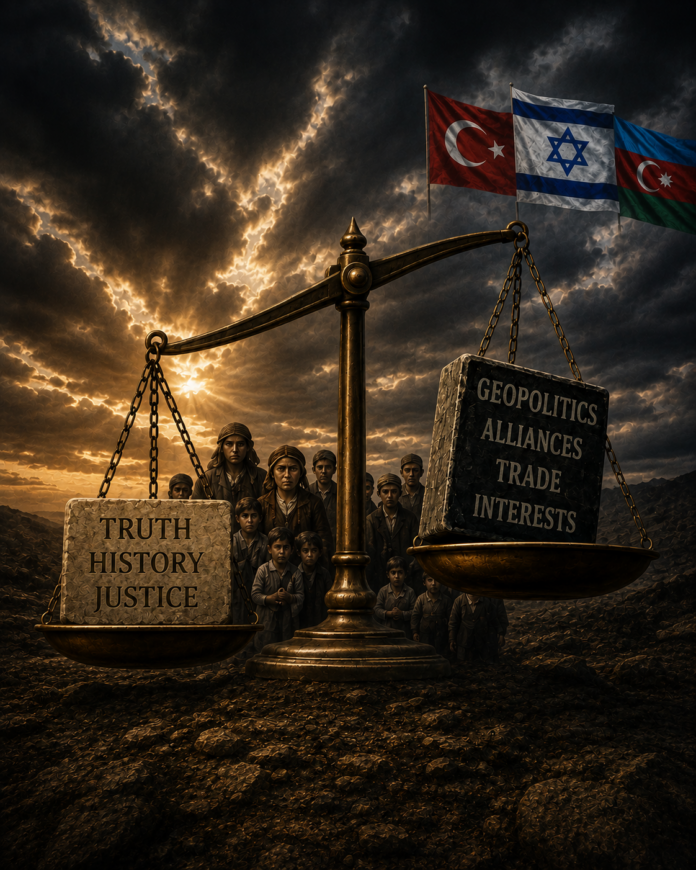
About a month ago, there was reason for a certain degree of optimism. The Israeli government had unanimously decided to recognize the Armenian Genocide, and Foreign Minister Gideon Sa’ar spoke of a moral and historical obligation, saying that it is never too late to do the right thing. It sounded significant and principled, and above all, like another step toward a future in which denial of the genocides of 1915 would eventually become impossible.
Many welcomed the news and celebrated it, and rightly so. Every country that recognizes a genocide helps strengthen historical truth. For us Arameans/Syriacs, however, there was an important objection from the very beginning: our people were not mentioned. Seyfo and its Aramean/Syriac victims were once again left in the shadows, despite the fact that our ancestors were subjected to the same violence, the same expulsions and the same policies of extermination. But that did not make the recognition of the Armenian Genocide any less important. On the contrary, we hoped that it might open the door to the next step, in which our people too would finally be included.
Then geopolitics caught up with the solemn words. The continued process in the Knesset was halted, while Azerbaijan reacted strongly and used its diplomatic relationship with Israel to influence the matter. Suddenly, that moral and historical obligation appeared considerably more complicated when weighed against strategic relationships and contemporary political interests.
This is where the truly interesting, but also deeply troubling, question arises. What does recognition actually mean when historical truth is allowed to depend on the diplomatic relationships of the present day? For many years, Israel’s relationship with Turkey has been a factor behind its cautious approach to the Armenian Genocide. As relations between Israel and Turkey deteriorated, recognition became politically easier. Then, when Azerbaijan — an important strategic partner of Israel — reacted, a new political obstacle emerged instead.
We must therefore be allowed to ask whether genocide recognition has, in practice, become a political instrument in the relationship between Israel and Turkey. When relations with Turkey are good, the issue is uncomfortable; when relations deteriorate, recognition becomes possible; and when another important partner objects, the issue suddenly becomes inconvenient once again.
But history does not change according to which states happen to be friends or enemies at a particular moment. The people who were murdered in 1915 do not become more or less dead depending on the security interests of Israel, Sweden, Turkey or Azerbaijan in 2026. A genocide remains a genocide even when recognizing it is diplomatically inconvenient.
Perhaps that is the bitterest lesson in all of this. We would like to believe that governments and parliaments recognize historical genocides because the documentation exists, because the research is clear and because the victims and their descendants deserve justice. Yet time and again we are reminded that states primarily look after their own interests. Trade, security policy, military cooperation, diplomatic relations and strategic alliances are weighed against one another, and somewhere within that calculation, historical truth is expected to find its place.
For us Arameans/Syriacs, this feeling is unfortunately all too familiar. We have waited for more than a century for Seyfo to receive the international recognition and place in history that this genocide deserves. Our villages were destroyed, our ancestors were murdered, and the survivors were driven from regions where our families had lived generation after generation. Yet we are still forced, time and again, to explain that we too were there and that our people were among those who suffered.
Even when recognition finally comes, we are sometimes not mentioned. The Israeli initiative concerned the Armenian Genocide, while the Arameans/Syriacs and Seyfo were not included. This is an omission that we must continue to point out, but the Armenians’ right to recognition does not become any less important because our people were not mentioned. We should welcome every recognition of historical genocide while at the same time demanding that the next step be taken. Every recognition is welcome, but ultimately every victim must also be recognized.
The problem becomes considerably greater when recognition itself begins to be treated as a diplomatic commodity. At that point, the history of the dead is reduced to a bargaining chip, and truth becomes something that can be highlighted when convenient and put aside when other political interests carry greater weight.
And Then We Come to Sweden
At the same time, it would be far too easy for us to point at Israel, Turkey or Azerbaijan and pretend that this problem exists only somewhere far away. We really only need to look at Sweden and at how the issue of Seyfo has been treated here for many years.
Sweden is now heading toward another election, and suddenly politicians are once again finding their way to our associations, churches, businesses, festivals and events. They knock on our doors, want to be photographed with our representatives, want to be seen among our people and are eager to tell us how important the Syriac community is to Sweden. Soon our votes will be counted, and suddenly we become interesting.
There is nothing wrong with politicians seeking contact with our organizations and our people. On the contrary, we should maintain dialogue with all democratic parties. But perhaps it is time for that relationship to become a little less one-sided. When politicians come to us, we should not simply listen to what they want to tell us. We must also begin asking what they actually intend to do about the issues that matter to us.
So, who among you out there is asking them about Seyfo?
When a Social Democrat knocks on the door, the question should be simple: Will your party work for a clear and consistent recognition of Seyfo and the genocide of the Aramean/Syriac people? And above all, what exactly do you intend to do about it?
Why should a Syriac automatically trust the Social Democrats simply because their representatives appear a few months before an election? Where are the results after all these years? Where is the consistency, and where is the willingness to pursue the issue even when there is no Syriac camera present and no Syriac votes immediately at stake?
Naturally, the same demands should be directed at the Moderates, the Christian Democrats, the Left Party and every other party seeking our votes. Over the years, individual politicians from several parties have shown genuine commitment, and that is something we should both appreciate and remember. But the commitment of individual politicians is not the same thing as a political party being prepared to take ownership of the issue and pursue it when doing so actually carries a political cost.
When a politician from the Left Party is asked about Seyfo and instead wants to redirect the discussion toward Gaza, Israel or today’s conflict in the Middle East, we must also have the courage to bring the conversation back to the question we actually asked. Gaza is one issue and Seyfo is another. The suffering of another people does not make the history of our people less important, just as the historical suffering of the Jewish people does not diminish our history. The Armenian Genocide does not make Seyfo less important, and Seyfo is not in competition with anyone else’s suffering.
Human rights and historical justice cannot function like a menu from which one selects the victims who best fit one’s own political or ideological compass. Anyone who demands justice for one people must be able to defend the same principle when it concerns another, even when that issue does not fit neatly into their own political narrative. Otherwise, we are no longer talking about a universal principle of human rights, but about political selectivity.
And that is precisely the selectivity we criticize when other states engage in it. We should therefore not accept it from Swedish politicians either, regardless of whether they come from the political right or the left.
Ask Before You Give Them Your Vote
When a politician stands before us, we do not really need to give a long lecture on history. The questions can be much simpler:
Do you recognize Seyfo? Is your party prepared to actively work for Sweden to clearly and consistently recognize the genocide of the Aramean/Syriac people? And what have you personally done about this issue so far?
It is no longer enough to say that one will “look into the matter,” that history is complicated or that foreign-policy issues must be handled carefully. Nor is it enough to attend a commemoration, deliver a beautiful speech before people who already know the history, and then forget about the issue until the next time there is a need to be seen among the Syriac community.
After all these years, we should start asking for political action instead of political sympathy.
What has now happened in Israel should therefore also serve as a lesson for us. We cannot build our historical justice on the hope that one day a government or political party will wake up and decide to make our cause its own. Politicians come and go, governments change, and international alliances can shift within a matter of months, while our history remains the same.
The recognition of genocide must therefore become an international standard in which historical research, documentation and facts carry greater weight than contemporary political relationships. A genocide should not have to pass through foreign ministries’ calculations of trade, weapons, security policy and strategic alliances before it can be called by its rightful name.
For small peoples such as ours, there is another lesson as well. We must continue documenting our own history, supporting research, telling the stories of our families and consistently demanding that Seyfo be named. We should continue welcoming every country that recognizes the genocides of 1915, even when that recognition is incomplete, while never accepting that our own people are written out of history.
And perhaps this is what we should remember above all when Swedish politicians now begin knocking on our doors ahead of the election. Do not only ask what they promise to do after the election. Ask what they have already done. Ask about Seyfo. Ask whether they are prepared to stand up for historical truth even when doing so carries a political cost.
Only then will we know what their words are really worth.
The day a genocide can be recognized without first being weighed against geopolitical relationships is the day truth will finally have taken precedence over politics.
Habib Dilmac, Sweden
